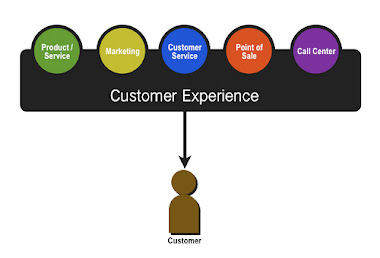
Sunday, 21 April 2013

Customer Loyalty is our Ultimate Criterion

I think that it is safe to state as a matter of fact that customer loyalty is key to business growth. Businesses that have customers who engage in more loyalty behaviors (e.g., stay longer, recommend, continue buying, increase share-of-wallet, more clicks/views) toward their company experience faster growth compared to businesses that have customers who engage in fewer loyalty behaviors. The key to growing one’s business, then, is to understand how to improve customer loyalty.
Seemingly disparate  fields in the CxM space, whether explicitly or implicitly, all focus on increasing customer loyalty (isn’t optimizing customer loyalty the goal of all business solutions?). These disciplines include:

Businesses Use Different Types of Customer Data to Increase Customer Loyalty

Each of the disciplines focus on using different types of customer data to increase customer loyalty. Businesses tailor ads that resonate with prospects’ personal values in order to attract types of customers (yes, some people are just more prone to buy, buy, buy; some are more likely to remain loyal).  Businesses target marketing/sales campaigns to specific customers based on customers’ purchase/service history. Businesses measure different types of customer loyalty via customer feedback tools to maximize the lifetime value of customers. It is clear that improving customer loyalty is not solely a service problem. Improving customer loyalty can occur throughout each phase of the customer lifecycle (from marketing and sales to service).

Customer Experience Management Defined

While there are existing definitions of customer experience management, they seem to focus solely on the measurement of customers’ perceptions and attitudes about the their experience. I believe that customer experience management programs, to be effective, need to consider two major types of customer data: 1) customers’ interactions with the company and 2) customers’ perceptions of their experience. The following definition of customer experience management reflects this idea.
Customer Experience Management (CEM) is the process of understanding and managing customers’ interactions with and perceptions about the company/brand.
Businesses are already realizing the value of integrating different types of customer data to improve customer loyalty. In my research on best practices in customer feedback programs, I found that the integration of different types of customer data (purchase history, service history, values and satisfaction) are necessary for an effective customer feedback program. Specifically, I found that loyalty leading companies, compared to their loyalty lagging counterparts, link customer feedback metrics to a variety of business metrics (operational, financial, constituency) to uncover deeper customer insights. Additionally, to facilitate this integration between attitudinal data and objective business data, loyalty leaders also integrate customer feedback into their daily business processes and customer relationship management system.

EFM and CRM = Effective CEM
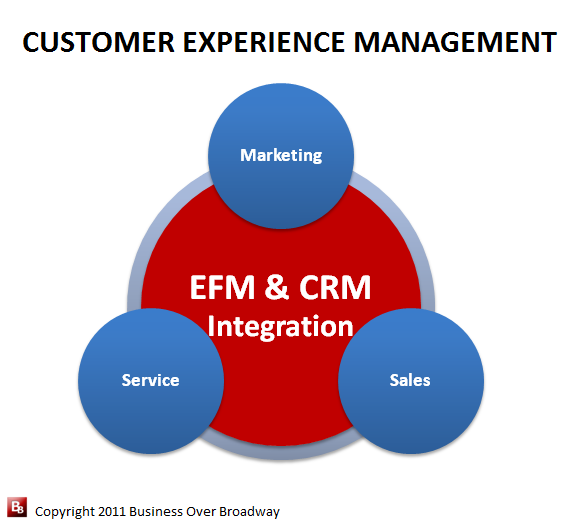
Customer Experience Management is EFM & CRM
CEM is the process of understanding and managing customers' interactions with and perceptions about the company/brand.
An effective CEM program provides a comprehensive picture of the customers’ interactions with the company as well as their attitudesabout the company. As such, the integration of CRM vendors andEnterprise Feedback Management (EFM) vendors (or, at least, the underlying business processes that support both) makes sense for any CEM initiative. For example, prior research at Siebel Systems found that Siebel customers who had customer satisfaction measurement associated with their Siebel applications reported greater gains inrevenue and user productivitycompared to Siebel customers with standalone Siebel implementations.
The integration of both types of customer data provides a comprehensive picture of the customer at the individual level and at the group level. Integration of customer data allows front-line employees to have immediate access to customer information necessary to resolve specific customer programs. Additionally, senior management can apply analytic techniques to this richer customer data to help understand the causes (operational, constituency) and consequences (financial) of customer satisfaction/loyalty, driving systemic changes that affect large customer segments.
A successful CEM program will help deliver a better customer experience. This goal is accomplished by the proper management of customers’ interactions with and attitudes about your product brand. The combination of behavioral and attitudinal data is more valuable than the sum of its parts. Successful CEM programs integrate different types of customer data together in order to gain deeper insight about their customers and what is important to them. EFM and CRM vendors have a great opportunity to demonstrate their combined value on the CEM space.

Customer Loyalty is our Ultimate Criterion

I think that it is safe to state as a matter of fact that customer loyalty is key to business growth. Businesses that have customers who engage in more loyalty behaviors (e.g., stay longer, recommend, continue buying, increase share-of-wallet, more clicks/views) toward their company experience faster growth compared to businesses that have customers who engage in fewer loyalty behaviors. The key to growing one’s business, then, is to understand how to improve customer loyalty.
Seemingly disparate  fields in the CxM space, whether explicitly or implicitly, all focus on increasing customer loyalty (isn’t optimizing customer loyalty the goal of all business solutions?). These disciplines include:

Businesses Use Different Types of Customer Data to Increase Customer Loyalty

Each of the disciplines focus on using different types of customer data to increase customer loyalty. Businesses tailor ads that resonate with prospects’ personal values in order to attract types of customers (yes, some people are just more prone to buy, buy, buy; some are more likely to remain loyal).  Businesses target marketing/sales campaigns to specific customers based on customers’ purchase/service history. Businesses measure different types of customer loyalty via customer feedback tools to maximize the lifetime value of customers. It is clear that improving customer loyalty is not solely a service problem. Improving customer loyalty can occur throughout each phase of the customer lifecycle (from marketing and sales to service).

Customer Experience Management Defined

While there are existing definitions of customer experience management, they seem to focus solely on the measurement of customers’ perceptions and attitudes about the their experience. I believe that customer experience management programs, to be effective, need to consider two major types of customer data: 1) customers’ interactions with the company and 2) customers’ perceptions of their experience. The following definition of customer experience management reflects this idea.
Customer Experience Management (CEM) is the process of understanding and managing customers’ interactions with and perceptions about the company/brand.
Businesses are already realizing the value of integrating different types of customer data to improve customer loyalty. In my research on best practices in customer feedback programs, I found that the integration of different types of customer data (purchase history, service history, values and satisfaction) are necessary for an effective customer feedback program. Specifically, I found that loyalty leading companies, compared to their loyalty lagging counterparts, link customer feedback metrics to a variety of business metrics (operational, financial, constituency) to uncover deeper customer insights. Additionally, to facilitate this integration between attitudinal data and objective business data, loyalty leaders also integrate customer feedback into their daily business processes and customer relationship management system.

EFM and CRM = Effective CEM

Customer Experience Management is EFM & CRM
CEM is the process of understanding and managing customers' interactions with and perceptions about the company/brand.
An effective CEM program provides a comprehensive picture of the customers’ interactions with the company as well as their attitudesabout the company. As such, the integration of CRM vendors andEnterprise Feedback Management (EFM) vendors (or, at least, the underlying business processes that support both) makes sense for any CEM initiative. For example, prior research at Siebel Systems found that Siebel customers who had customer satisfaction measurement associated with their Siebel applications reported greater gains inrevenue and user productivitycompared to Siebel customers with standalone Siebel implementations.
The integration of both types of customer data provides a comprehensive picture of the customer at the individual level and at the group level. Integration of customer data allows front-line employees to have immediate access to customer information necessary to resolve specific customer programs. Additionally, senior management can apply analytic techniques to this richer customer data to help understand the causes (operational, constituency) and consequences (financial) of customer satisfaction/loyalty, driving systemic changes that affect large customer segments.
A successful CEM program will help deliver a better customer experience. This goal is accomplished by the proper management of customers’ interactions with and attitudes about your product brand. The combination of behavioral and attitudinal data is more valuable than the sum of its parts. Successful CEM programs integrate different types of customer data together in order to gain deeper insight about their customers and what is important to them. EFM and CRM vendors have a great opportunity to demonstrate their combined value on the CEM space.

E V E R L A N E

Customer Experience Associate

At Everlane, we’re rethinking the way retail works. We have no physical stores, no middlemen taking their cut and no brand markups. Instead, we design our own luxury basics and sell them exclusively at Everlane.com. Since launching in November 2011, Everlane has attracted over 400,000 members and has been featured in The New York Times, New York Magazine, The Economist, Elle, and GQ.
Everlane is seeking to reinvent customer service on the web from the ground up and create a best-in-class experience. We are looking for smart, passionate individuals who love to help people and are quick at problem solving.
You will engage with our customers, answering their questions, and making sure they’re thrilled with Everlane. You should be likeable, think quickly on your feet, and be extremely organized. This position is ideal for someone who enjoys people and wants to join a fast-growing design brand.
This position is based in San Francisco.
Responsibilities:
  • Deliver a great experience to Everlane customers day in and day out, fielding all incoming questions from customers and new members
  • Be the eyes and ears of customers, reporting issues back to the company so that we can continuously improve and iterate on our product
  • Process returns, manage tickets, deal with one-offs, etc
  • Keep track of key issues and develop new programs to better the experience for members
  • Work closely with the web team and our warehouse when relevant issues arise
  • Develop new programs beyond the everyday that set Everlane apart (e.g. reaching out to new members, following up with top customers, etc)
  • Act as a brand ambassador outside the Customer Experience team
Skills and qualifications:
  • Bachelor’s degree
  • Passionate about helping people, ambitious and self-motivated
  • Exceptional communicator (best in your group) and very organized
  • Quick to solve problems, and a very go-getter attitude
  • Eagerness to learn and able to juggle many tasks
  • Empathetic and extroverted, you’re liked by all and able to lead groups to accomplish great tasks
Time and benefits:
  • Full time position that generally Monday through Friday with alternating weekend shifts
  • Opportunity exists within the company to grow based on performance
  • Health benefits are included

Saturday, 20 April 2013


5 Important Characteristics of Generation Y, the “Millennials”
Understanding the characteristics and the consumer DNA that make Generation Y unique will help you identify ways that your business can provide value to them through products, services and of course, CONTENT! After all, providing value is the first step to gaining customers.
TIP: Use this information to help you get to know your target audience

1. Tech Savvy

Millennials grew up with easy access to computers, constant connection to the internet, and smart phones in-hand. They’re accustomed to using technology in every part of their lives and fully believe in its power to make their lives easier. You could even say that they’re intolerant of companies and individuals that aren’t equally as savvy.
What’s this mean for you as a company looking to engage and serve this demographic?Make sure your company’s website and mobile site offer a simple, efficient experience. Look through your sales workflows and product offerings, asking “how can I make working with my company easier to do online?”
IDEA: Ask yourself, is there an app for that? Is there an app that your company could create to help your customers manage their accounts?

2. Ambitious

This generation dreams without limits. They’re in search of two things – money and happiness.
What’s this mean for you as a company looking to engage and serve this demographic? Win these lofty dreamers over by helping them reach their goals with practical resources and real product solutions.
IDEA: Create a content marketing strategy that connects millennials to products, philosophies and services that help them reach their dreams. Specifically, show them how your products will help them.

3. Fickle

Wonder why you receive resumes with five employers in less than five years? This is why! Members of Generation Y are constantly searching for the next best thing and when they find it (or think they find it) they’ll jump on it!
What’s this mean for you as a company looking to engage and serve this demographic?Don’t stay stagnate! Consistent improvement will continually demonstrate that you ARE the next best thing.
IDEA: Rework your website landing pages to not only outline the benefits of your products and services, but also to highlight how they have impacted your customers’ lives.

4. Communicators

Instead of passing notes and calling a friends’ house, millennials grew up trading text messages and chatting online. They’re used to communicating quickly without ever saying a word. This is why they’ll rapidly respond to text and email but stare at the phone for days giving themselves a pep talk before returning a call.
What’s this mean for you as a company looking to engage and serve this demographic?Make it convenient, easy and even fun to connect and communicate with your company online.
IDEA: Offer live-chat on your website to answer any questions.

5. Impatient

A life of instant gratification has created an extremely impatient generation of people. They’re quick to spend and intolerant of wait times.
What’s this mean for you as a company looking to engage and serve this demographic?Make it extremely easy to purchase now and receive a response or product fast. An example of a corporate solution that caters to Generation Y’s impatience is “1-click ordering” by Amazon.
IDEA: Host your support questions and answers in an easily searchable knowledge hub on your website.